Showing posts with label crown. Show all posts

Thursday, March 27, 2014

What's that Word? Dental Jargon from A to Z: O is for Occlusion

Occlusion is the manner in which upper (maxillary) and lower (mandibular) teeth contact and rest on one another when they are brought together to close the mouth or chew, commonly called bite.


Dynamic occlusion, or articulation, is the occlusion when there is jaw movement.  This includes when you are eating.  Static occlusion is occlusion when the jaw is closed and is not moving.

Dynamic Occlusion
Static Occlusion

When there is improper contact resulting in misalignment, it is called malocclusion.  Malocclusion is associated with a variety of problems.


Both genetic variation and environmental factors affect occlusion and can result in malocclusion, since bone structure and the size, shape, and location of teeth vary between people.  Tumors, impacted teeth, pacifier use, improperly fitted oral appliances, wear/abrasion, restorative treatments (such as braces, fillings, invisalign, and crowns), breathing though the mouth, biting on nails or other objects, thumb sucking, and injury can also lead to malocclusion.
As a person ages and develops, their occlusion may change.  Remember that many infants are born without teeth, baby teeth erupt and are gradually replaced by permanent teeth.  All teeth are subject to wear and infection.  People may also have supernumerary (more than a normal number of) teeth, may be missing teeth, or may have large, small, or loose teeth, which may lead to malocclusion.


Malocclusion should be treated by a dentist.  A dentist will be able to evaluate a patient and check for malocclusion.

Wednesday, August 28, 2013

What's that Word? Dental Jargon from A to Z: I is for Implant


A dental implant is a restoration in which a missing tooth is replaced with a support structure which is inserted into the bone, similar to the root of a natural tooth.  The post, with time, undergoes osseointegration, forming a connection with the bone.  Dental implants are often made of titanium.  They are connected to abutments which support prostheses such as crowns. 


Dental implants can be used to replace a single tooth, multiple teeth, or support a denture.  Implants provide support to dental restorations.


What is the difference between a dental implant and bridge?

An implant is inserted into the dental alveolus (socket in the bone which holds the tooth).  When only one tooth is missing, it simulates the placement of a single tooth.  A dental implant is a replacement for a natural tooth.  A dental bridge is attached to surrounding natural teeth after they are filed, which results in the loss of natural tooth structure. When possible, many dentists advise patients to maintain the maximum amount of natural tooth structure.  Bridges and implants also differ in cost.  

implant restoration three-unit fixed bridge

Thursday, June 27, 2013

What's that Word? Dental Jargon from A to Z: R is for Root Canal


The mere mention of the phrase root canal leaves many Americans quivering in fear.  It's the most stereotypically feared dental treatment.


Whether performed by a general dentist or an endodontist, a root canal is performed to remove infected tissue such as nerve tissues and blood vessels from the pulp of the tooth and seal it against future infections.  Files and irrigating solutions are used extensively in this process.

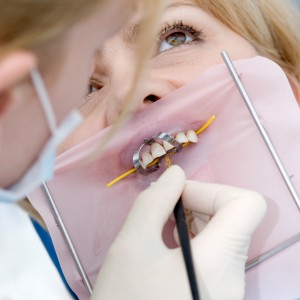
Rubber Dam


How is this done?  First, the dentist takes x-rays to identify infected areas. Then, the area is numbed and a rubber dam is placed on the tooth to keep it dry and bacteria-free. The rubber dam also prevents bacteria from the infected tooth from being transferred to other parts of the mouth. Afterwards, a hole is drilled into the tooth and bacteria is removed from the tooth. It is then cleaned with root canal files, which reach into the tooth and clean and scrape the sides of the root canals.  Sodium hypochlorite or water is then used to clear any debris.  To seal the tooth, it is filled and closed with a crown following the root canal.

The procedure normally takes approximately one hour.


Why is a root canal sometimes performed by an endodontist?

  • Endodontists complete several years of focused additional studies following the completion of a four year program in general dentistry.  This enables them to diagnose and treat complex cases and teeth which have had a past root canal.  
  • If your case requires an endodontist, your general dentist will refer you to one during your normal cleaning appointment.  Feel free to also consult ratings guides before choosing an endodontist.  
Fun Fact: We are not the only species that gets root canals.  

Hati the tiger, of the Miami Zoo, getting a root canal

What's that Word? Dental Jargon from A to Z: T is for Teeth


Let's get down to the basics. 

Why do we have teeth?
Teeth can be used for chewing food, defense, and hunting.  We mainly use them to break down food.

Fun Fact: Chewing is the first step in digestion.  The mechanical motion of chewing as well as the chemical ingredients of saliva, such as salivary amylase, an enzyme that breaks sugars down into starch, and bacteria.  


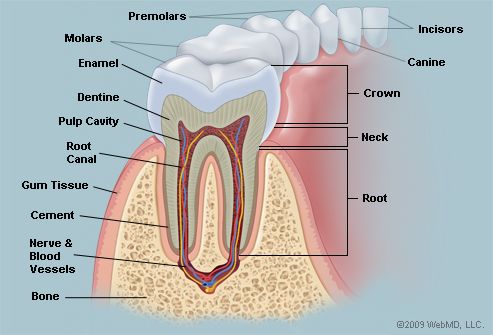
What are the parts of the tooth?
  • Crown: the exposed portion of the tooth covered by enamel that sits above the gumline
  • Root: portion of the tooth that secures it in place in the gum tissue and bone
  • Enamel: hard covering of the crown that protects the dentine
  • Dentine: living supportive part of tooth that has some nerves
  • Pulp: tooth center which houses many nerves and blood vessels; part of the tooth that receives nourishment
  • Cement: covers root and attaches tooth to the bones of the jaw


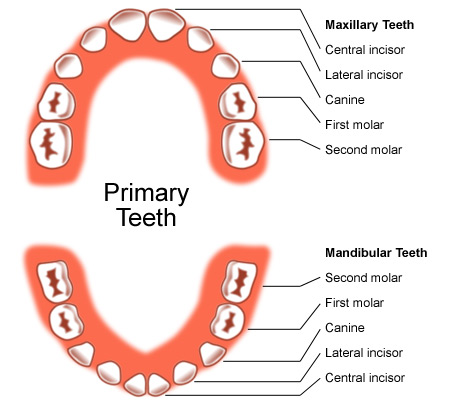
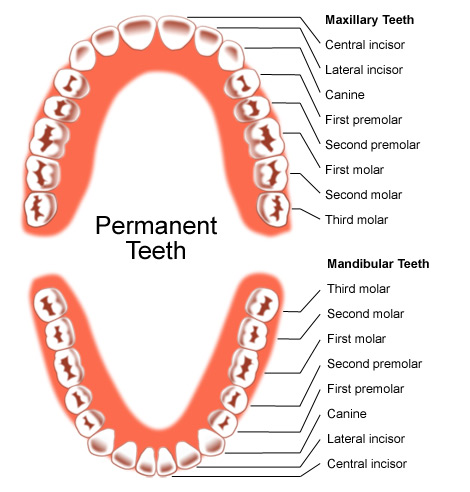
Since humans eat a mixture of meat and plant products, our teeth have incisors, canines, pre-molars, and molars.  Paleontologists can determine a skeleton or fossil's species and eating habits  by examining its teeth.


We are diphyodonts.  This means that we have two distinct sets of teeth.  The first set is known as deciduous, baby, milk, or primary teeth.  These teeth typically emerge during infancy and are replaced by permanent adult teeth.  We typically have 20 teeth as children and 32 as adults.


Fun Fact: Walrus tusks are actually canines!  These teeth grow continuously throughout the life of the walrus.